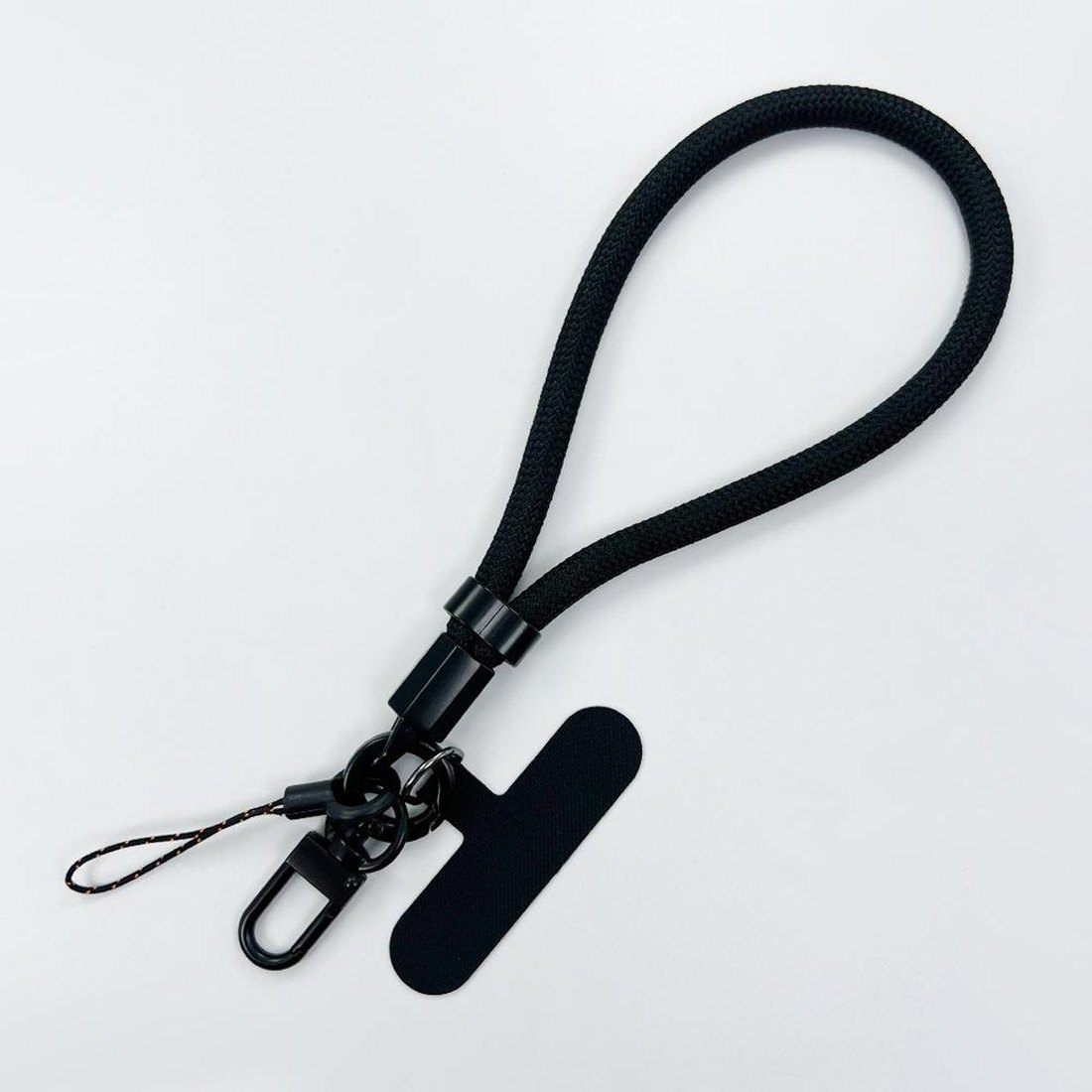
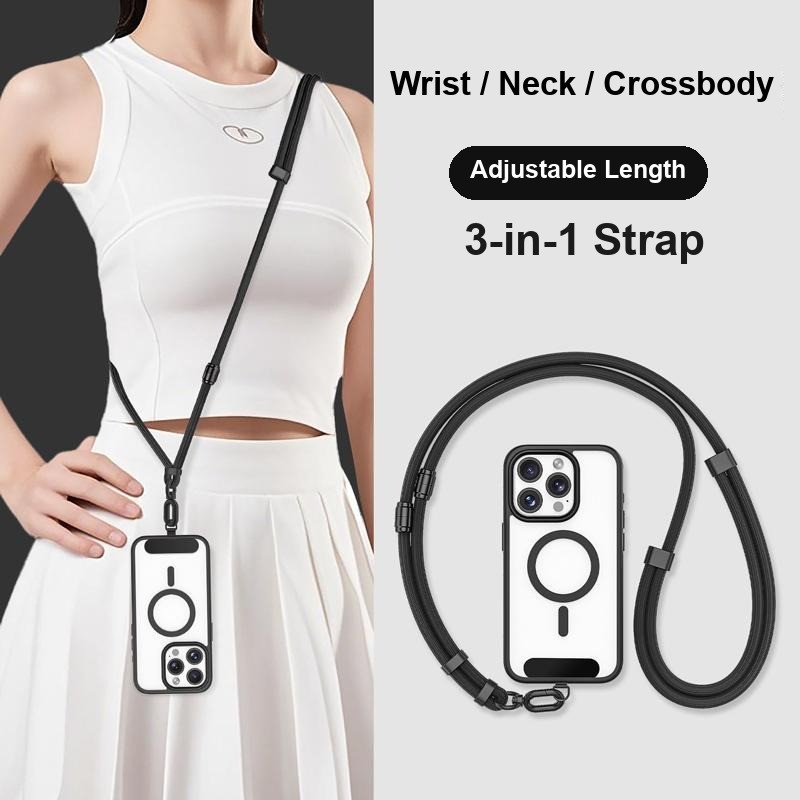
The short version: on a phone lanyard, the connector is the part that decides whether the product works. The strap is visible; the connector is structural. Choose it by thickness first (it has to sit between the phone and the case without lifting the case), by rotation second, and by finish last. This page covers the parts and how they fit together.

The connector is the failure point
A phone lanyard only fails in one place — the joint. Cord does not snap, webbing does not tear, and a correctly made clip does not open on its own. What fails is the connection between the strap and the phone, and that connection is hardware.
So when comparing lanyard suppliers, compare the connector specification first. Price differences in this category almost always trace back to it.
Tether tabs and anchor plates: thickness is the whole argument
A tether tab or anchor plate is a thin metal pad that goes between the phone and its case. A loop, ring or D-ring protrudes from the bottom, and the lanyard clips to that.
Thickness is what makes or breaks it. Our pads run from 0.18 mm to 0.4 mm stainless steel:
- Around 0.18 mm — the ultra-thin end. Best for slim cases and for anyone who does not want to feel the plate at all. Common on beaded and charm styles.
- 0.3 mm — the middle ground, used on many braided wrist styles with hollow or cut-out details.
- 0.4 mm — the stiffest and most durable. Takes custom outlines, custom D-ring sizes, printed artwork and laser-engraved logos, and it stands up to repeated attach and detach.
All of them have to do one job above everything else: keep the charging port clear and not lift the case off the phone.
Anchor plate versus patch: what the difference means in practice
These two words get used loosely. In our range:
- Anchor plate — rigid metal, with a formed ring or D-ring, load-bearing. This is the structural part.
- Patch — flat and decorative or semi-structural. A TPU patch behind a phone case spreads load and protects the case surface; a printed steel patch is a branded component.
- Tether tab — the specific thin, flat version that threads between phone and case.
- T-patch — the T-shaped version that sits flush at the bottom edge and gives the strap a straight pull direction.
If a supplier cannot explain the difference between these in their own range, they are probably reselling rather than specifying.
Swivel clips, sliders and buckles
Three mechanisms, three jobs:
- 360° swivel clip or hook. Lets the phone rotate freely so the strap does not twist into a knot in your hand or against your body. An anti-tangle hook does the same job with a hollow head. This is the single most noticeable upgrade on a wrist strap.
- Slider. A friction element that lets the user tighten the loop to the wrist or shorten a strap. Without one, a loop is a fixed size — which is fine for a neck strap and wrong for a wrist strap.
- Buckle. A threaded locking buckle or a security buckle holds a length setting under load so the strap does not drift during the day. On 3-in-1 straps it is what makes the conversion between wrist and crossbody actually stay put.
Making hardware work as one system
The most common design mistake we see in lanyard ranges is hardware that does not fit together. A clip that is too large for the ring it is supposed to attach to. A swivel hook whose gate does not clear the D-ring. A slider whose inner diameter does not match the cord.
That is why we treat connectors as a system rather than as loose parts: clips, sliders, swivel hooks, T-patches, anchor plates and rotating connectors specified so they assemble with each other. It also means a customer can buy hardware separately and know it will fit the strap they already have.
Finishes, and what they cost you
Finishes on the same part behave differently on the shelf and on the body:
- Matte — hides handling marks best; the safest choice for retail and for products that get used hard.
- Nickel — the familiar metal look; shows fingerprints sooner.
- Gold-tone and rose-gold — strongest fashion signal, best on charm and beaded styles where the hardware is part of the design.
Hardware colour also has to be matched to the cord or webbing, and to the anchor plate. Mismatched metal is the fastest way to make a well-made product look cheap.
Minimums and custom hardware
A stock clip in a stock finish is a 100 pcs conversation. Custom metal — your own plate outline, your own D-ring size, laser-engraved logo, or a custom shape — generally starts around 500 pcs, because tooling has to be cut and it only pays off at volume.
If you want custom hardware, the cheapest path is to send a drawing, a sketch or a reference part. We will come back with tooling cost, unit cost and lead time — not a guess.
Where to go next
- Lanyard accessories & hardware — tether tabs, anchor plates, swivel hooks and connectors.
- Phone wrist straps — where the connector choice shows most.
- Sourcing guide — how to write the specification that includes all of this.